INVISIBLE RHYTHMS
CURIOSITY IS NOT A CAREER MOVE

There’s a point where curiosity starts to look irresponsible. Not reckless — just inefficient. It doesn’t line up neatly with progress charts or five-year plans. It doesn’t announce where it’s taking you. It just pulls.
And the world, on the whole, is not patient with pulling. The world wants to know where you’re going. What this is for. How it connects to the thing you were doing before. There’s an assumption built into most professional environments — and into a lot of personal relationships too — that your attention should be directed, purposeful, and explainable at any given moment.
Curiosity, real curiosity, doesn’t work that way. It doesn’t ask for permission and it doesn’t file progress reports. It just keeps pointing at things and saying: look at that. Stay with that. There’s something there you don’t understand yet.
Learning to trust that voice, and to protect the space it needs to operate, is one of the central disciplines of a creative life. Not the glamorous discipline — not practice or craft or the ten thousand hours. The quieter one. The discipline of not explaining yourself before you understand what you’re doing.
That’s usually when people try to turn curiosity into a strategy. They ask: How does this fit? What does this lead to? Can I justify spending time on this? Most of the time, you can’t. And that’s the point.
The justification comes later, if it comes at all. And when it does, it’s usually in a form you couldn’t have anticipated. The thing you followed without knowing why becomes, three or five or ten years later, the exact thing that makes a new project possible. The connection was always there. You just couldn’t see it from where you were standing.
I’ve lived this enough times to trust it now. But I want to be honest: trusting it doesn’t make it comfortable. Even now, after sixty years of evidence that the curiosity tends to know things my rational mind doesn’t, there are still moments of doubt. Still mornings when the thing I’m drawn to looks, from the outside, like avoidance or indulgence or a failure of focus.
The doubt doesn’t go away. You just get better at not letting it make your decisions.
Staying With What You Don’t Understand
When I moved to Seattle, I wasn’t arriving with a plan. I was in a period of exploration that had no immediate “professional” outlet. I went out frequently — not just to music clubs, but to avant-garde theater, contemporary dance performances, and art galleries. None of it was strategic. I wasn’t collecting influences for a specific record. I wasn’t looking for a next identity. I was simply paying attention.
Seattle in that period had a particular quality of creative ferment that I don’t think gets enough historical credit. It was a city that hadn’t yet been fully claimed by any single aesthetic movement — which meant there was room for genuinely strange and original work to develop without the pressure of having to position itself in relation to an established scene. You could make things that didn’t fit anywhere, and find an audience for them, because the city itself didn’t quite fit anywhere yet.
I found that disorientation useful. Coming from a world where my identity had been clearly defined — arriving somewhere that didn’t particularly care about any of that had a liberating quality. I was anonymous in the most productive sense. No one was waiting for me to be anything. I could just pay attention.
It is the discipline of lingering in the doorway of an experience that doesn’t yet make sense, allowing the unfamiliar textures of a performance or the stark silence of a gallery to seep into your senses without immediately asking what it means or how it fits.
Lingering in the doorway is not about passive consumption. It’s about a specific quality of attention that holds the experience open rather than closing it down too quickly with interpretation. The mind wants to categorize, to file, to move on. Real curiosity resists that impulse. It stays in the unresolved space longer than is comfortable.
Most of us are trained out of this capacity early. School rewards the quick answer, the correct categorization, the ability to demonstrate understanding on a timeline. What it doesn’t reward — and what genuine creative development requires — is the willingness to sit with something you don’t yet understand and trust that the understanding will come if you stay present long enough.
The artists and musicians I’ve learned the most from all had this capacity in abundance. They weren’t necessarily faster thinkers or more technically gifted than others in their field. They were more willing to not know. To stay in the question.
One of the artists I sought out during this time was Trimpin. He is a sound artist and inventor whose work — massive kinetic sculptures that play themselves, automated pianos suspended in air, mechanical contraptions that produce music through elaborate Rube Goldberg systems of weights and levers and bells — exists in a space between art and engineering that most people don’t even know is available.
Encountering Trimpin’s work for the first time was like being shown a door in a wall you’d been looking at for years without seeing it. He wasn’t a musician in any conventional sense. He was something harder to name — an architect of sonic possibility, a man who had decided that the distinction between composing and building was arbitrary and had chosen to ignore it.
His studio was like nothing I’d ever been in. Instruments that didn’t exist anywhere else in the world. Machines that had been designed to play specific pieces of music that couldn’t be played any other way. The relationship between intention and sound had been made visible, mechanical, structural. You could see the music happening.
What struck me most was the quality of his attention. He worked with the patience of someone who had completely abandoned the idea of a deadline. Not because he was undisciplined, but because the work itself was the discipline. The timeline was irrelevant. The question was whether the thing was right.
Eventually, we became friends. Being around someone like Trimpin reinforces the idea that you don’t have to stay within the lines of your “craft.” You can be a builder, a dreamer, and a technician all at once. The boundaries are self-imposed.
The boundaries are self-imposed. Not always consciously — sometimes they’re absorbed from the environment, from the industry, from the accumulated expectations of people who knew you at a particular moment in time and couldn’t quite update their picture of you as you changed. But they’re still self-imposed in the sense that you’re the one choosing to honor them.
Trimpin had never honored them. Not out of rebellion — he wasn’t making a statement — but simply because they’d never been real to him. He’d always existed in the space where the question was just: what does the work require? Not: what does my category permit?
Being around that kind of freedom is contagious. Not immediately, and not without its own kind of difficulty. But over time, the proximity to someone operating without those invisible fences changes how you see your own.
The Pressure to Decide Too Early
There’s a cultural impatience around direction. People want to know what you’re doing. What you’re becoming. What this “phase” is for. But many of the most consequential shifts don’t announce themselves. You linger longer than expected. You return to the same questions without answers. You keep circling material that doesn’t yet have a shape.
From the outside, it can look like indecision. From the inside, it’s calibration.
The distinction is real but hard to defend in the moment. Indecision is the absence of a direction. Calibration is the process of finding one. They can look identical from the outside, which is why the social pressure to explain yourself — to produce a narrative that makes sense to other people — can be so damaging during periods of genuine exploration.
I’ve watched talented people abandon important work because they couldn’t articulate what it was for. Not because they lacked conviction, but because the work was in a phase that didn’t yet have language. They needed time. The environment didn’t give it to them. And so they defaulted to something explainable, something that fit the expected narrative, and the other thing — the thing that had been pulling them — quietly receded.
That loss is real. And it’s remarkably common. The creative life is full of things that almost happened, directions that almost got followed, frequencies that almost got trusted. The gap between almost and actually is often just this: the willingness to stay in the unexplained space long enough for the explanation to arrive.
The problem isn’t that people change direction; it’s that they are pressured to explain why before they actually know.
There’s a useful practice I’ve developed over the years for navigating this pressure. When someone asks what a new direction is for — and the honest answer is that I don’t fully know yet — I’ve learned to say exactly that. Not apologetically. Just accurately. ‘I don’t know yet. I’m following something. I’ll know more when I’ve followed it further.’
Most people find this unsatisfying. A few find it clarifying. The ones who find it clarifying are usually the ones worth keeping close.
Because here’s what I’ve found: the people who need you to explain yourself before you’ve understood what you’re doing are, usually, managing their own anxiety about uncertainty. Your inability to provide a clear narrative makes them uncomfortable. That’s a real feeling and it deserves compassion. But it’s not your problem to solve at the expense of your own process.
Letting Time Do Some of the Work
One of the advantages of aging is that you begin to trust time as a collaborator. When you’re younger, there’s a sense that every pause is dangerous — that if you don’t act quickly, the moment will disappear.
Later, you realize something else: some things only reveal themselves if you stay with them long enough. Not push. Not optimize. Just stay present.
This is one of the most significant shifts I’ve experienced in my own creative life. The relationship to time changes. In the early years, time feels like an opponent — something to work against, to outpace, to fill. Every moment of apparent stillness carries the anxiety of falling behind.
At some point, and I can’t pinpoint exactly when it happened, that changed. Time started to feel more like a medium than an opponent. Something to work with rather than against. And that shift changed everything about how I approached the work.
Projects that I would have forced to completion in my thirties, I now let breathe. Not indefinitely — there’s still the discipline of finishing, of not letting the breathing become avoidance. But the compulsion to fill every silence, to produce constantly, to demonstrate productivity as a form of legitimacy — that quieted considerably. And what moved into the space it vacated was something more interesting. A quality of attention that could only exist in the absence of urgency.
We spend so much of our lives trying to manufacture urgency, forgetting that the most profound insights are often like shadows that only appear when the light is at a specific angle, requiring us to slow down, to wait, to allow the moment to find its own form.
That image — shadows that only appear at a specific angle of light — describes something I’ve experienced countless times in the studio. The track that isn’t working, that you’ve been pushing at for hours. The moment you step back, take a break, stop trying. And then something in the room shifts. The angle of attention changes. And suddenly you can hear what the track actually needs, which is almost never what you’ve been trying to give it.
This is not mysticism. It’s neuroscience. The focused, effortful brain is extraordinary at executing known processes and solving problems with clear parameters. But the insight brain — the one that makes unexpected connections, that hears what isn’t there yet, that knows things the analytical mind hasn’t caught up to — that brain operates differently. It needs space. It needs the reduction of effort. It needs you to stop pushing.
Learning to create the conditions for that kind of insight — deliberately, reliably, as a practice rather than an accident — is one of the most valuable things a creative person can develop. And it starts with the simple, difficult act of trusting that not pushing is sometimes the most productive thing you can do.
Curiosity doesn’t reward urgency. It rewards endurance.
Endurance is the right word. Not stamina, which implies sustained effort. Endurance is something quieter — the capacity to stay in relationship with a question across long stretches of time, through periods of apparent inactivity, through the moments when nothing seems to be happening and the pressure to move on is loudest.
The questions that have mattered most in my life have been with me for decades. Not obsessively, not constantly, but persistently. They go quiet for a while and then surface again, usually when I’ve moved into new territory that creates a new angle of approach. Each time they surface, I understand them a little differently. Each iteration adds a layer.
That’s what endurance looks like from the inside. Not grinding. Not forcing. Just staying in relationship with the thing that interests you, across however long it takes, trusting that the relationship itself is doing work even when nothing visible is happening.
Curiosity, in the end, is not a career move. It’s a way of being in the world. And like all ways of being, it requires protection — from the pressure to be useful, the pressure to be legible, the pressure to produce on a timeline that someone else has set.
Protect it. Everything else grows from there.
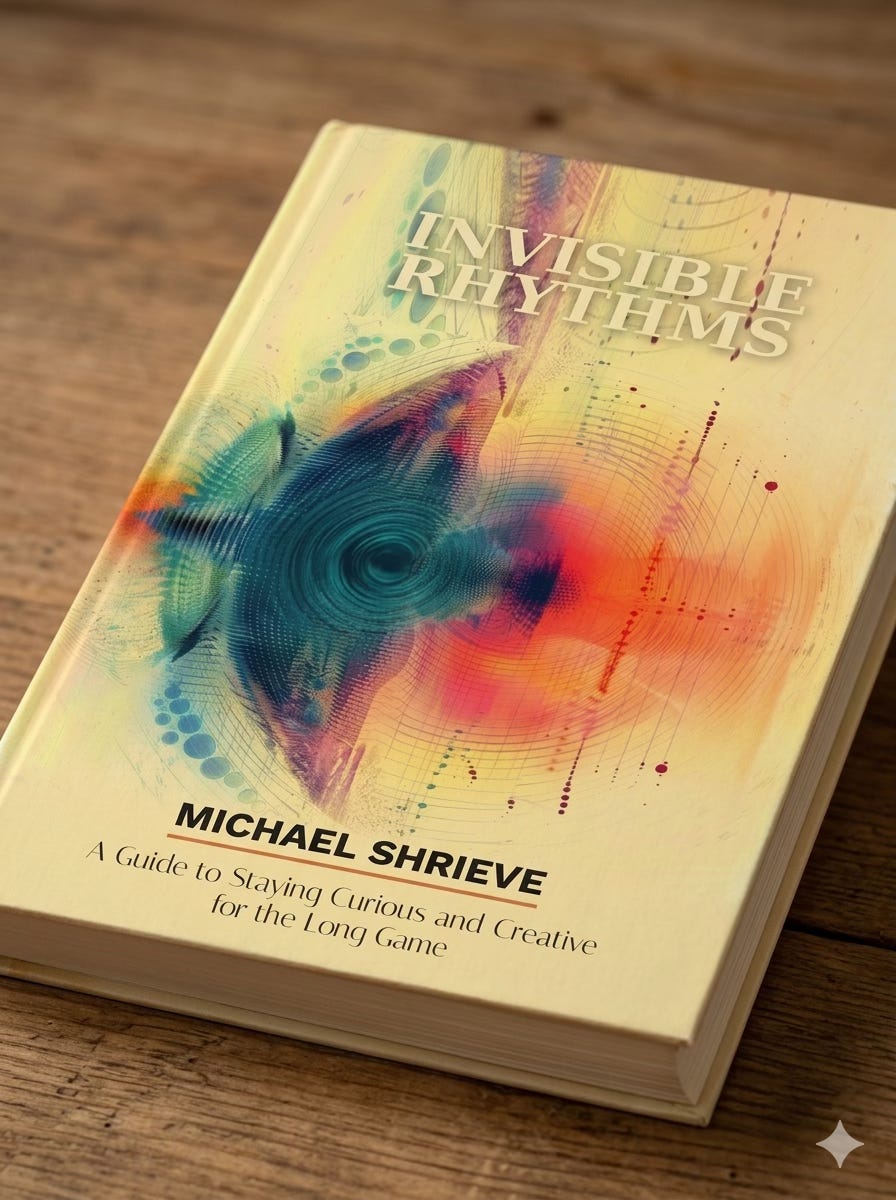
Invisible Rhythms is available now on Amazon in Paperback, Hardcover, and Kindle

This is one of the most profound things I've read. Ever. Thank you very much.